
Table of Contents
- Signifiers and signifieds: how do we relate words with things in the world?
- Literature and the aliveness of language
- Literature reframes the meaning of words and our relationship with them
- An example: experiencing literary alchemy in Jane Austen
- The point of equilibrium where meaning and reality come together
“Discourse will indeed have the task of saying what is, but it will be nothing more than what it says.”
“One could say, in a sense, that ‘literature,’ as it constituted and designated itself at the threshold of the modern age, manifests the reappearance, where one did not expect it, of the living being of language.”
“In the modern age, literature is what compensates for (and not what confirms) the signifying function of language.”
Michel Foucault, The Order of Things, an Archeology of the Human Sciences, 1966.
Signifiers and signifieds: how do we relate words with things in the world?
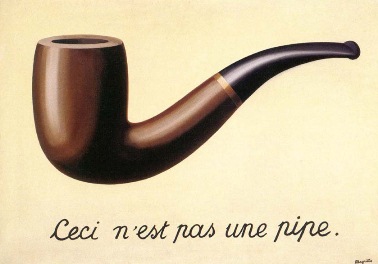
“…but it will be nothing more than what it says.”
In its ordinary use, we speak of language as working under a binary regime. Words, sentences, and paragraphs are interpreted as essentially being signs. These are binary because they comprise two elements: a signifier and a signified. The sign itself is what bundles these two elements together. For instance, the signifier “dog” signifies the idea of a dog. So, when we use the word “dog”, we are invoking this idea of a dog; we are signifying it.
Some could argue that we are in fact in a ternary regime, because the sign is also tied, albeit indirectly, to the real thing itself. The real dog that is next to us is a particular instance of the universal idea of a “dog”; its unique characteristics —physical traits, behaviour, personality, anecdotes associated with it, emotional attachment, roles— condition the meaning of the sign “dog” as we utter it in any specific moment. This doesn’t alter the dictionary definition of what a dog is in its simplest terms, but it expands its semantic domain: its possible additional meanings, what other accessory descriptions are compatible to the idea of a dog, and so on. This occurs because many people have their own personal experience being with dogs in real life, and all the details they observe in these real experiences with dogs bring additional possible associations to their ability to speak about them.
On the other hand, when we speak of signs being binary, we subscribe to the belief that the word “dog” refers only to a fixed concept of a “dog”, not the reality of an actual dog. Real dogs may vary in their characteristics and rise above, or outrun, the conceptual definition of a dog, but the definition itself remains unchanging; it is static, confined within clearly delimited, abstract conceptualisations.
In other words, the meaning of the sign “dog” is predetermined, it “says what it is, but it will not be anything more than what it says”. We won’t begin with “dog” as an empty signifier (a signifier waiting for us to point at something and declare it as its signified), point to our friend’s dog, and observe it in order to infuse the signifier “dog” with meaning according to the characteristics of this real animal in front of us. Instead, we will simply draw this signifier’s limits according to the simplest, irreducible collection of traits that can only make us think of a dog —that is, the fixed representation of a dog to which the word “dog” corresponds: traits present in every single dog across the board, yet never perfectly corresponding to any actual dog.
The ternary regime is less precise. It predates the idea of language’s potential as a vehicle for objective rational discourse, where we can strip our observations of phenomena from any subjective qualifier so we can describe objective reality in its mechanical essence: physical objects interacting within the confines of physical laws (humans included, insofar as we faithfully adhere to evolutionary psychology and neuroscience as the hard science explanations of humanity). The ternary regime is an expression of what Foucault in this citation calls “the living being of language” or l’être vif du langage.
To my understanding, he is referring to this fluid relationship with that third and elusive element connected to the sign. This element is reality itself.
Literature and the aliveness of language
“…the living being of language.”
One of the functions that literature fulfils is the reaffirmation of that alive quality of language.
First of all, literature was defined as a separate domain of human knowledge-making fairly recently. In the great 19th century project of rigidly distinguishing institutionalised domains of human endeavour, the idea of literature was carved out in contraposition to “humanistic academia”, “journalism” and “scientific writing” —an artificial operation similarly applied to the domain of “religion”, which became distinctly separated from that of “secularism”.
Right now I am speaking of this particular demarcation of what literature is: a realm where language is exclusively devoted to poetry, prose, novels, short-stories, genres of fiction, and so on. And I think that the particular way in which literature employs language —and is constituted by it— essentially manipulates signifieds, thereby reinvigorating their signifiers.
What I mean is that literature contains dense, sensorially and subjectively rich descriptions of events, alongside unique ways in which it arranges phenomena to present narratives in a light specific to each literary work (narratives being sequence of events, of interactions between beings oriented towards some form of transformation, underpinned by an arc of beginning, middle, and end).
By executing this vast semantic operation, literature creates new representations saturated with meanings that draw from reality in a holistic manner: through a keen awareness of input from all perceptual senses, through free association, subjective experience, playful (that is, unruly as opposed to systematic) empirical observation, narrative movement (including context: signified things shaped by their interrelations with contextual phenomena and the passing of time), poetic connection via new metaphors, perception and interpretation through the lenses of emotions, an intention to articulate aesthetic experience and evoke the beauty in things and moments, and so forth. These holistic representations are what constitute a manipulation of signifieds.
We can gain more clarity about this mechanism of manipulation if we think about it through the aforementioned ternary regime: there is a signifier, a signified, and a reality. The writer seeks to represent an experience situated halfway between reality and imagination (which may be pure fictional creation, but invariably draws at least partly from the subjective experience of reality) through the use of words, which themselves function as signs. To avoid confusion, the signifier, as opposed to the sign, is also represented by the word, although only in the sense of the arrangement of letters that form it, prior to our consideration of its meaning.
Only when this letter arrangement is linked with a signified —which itself attempts to capture some aspect of reality (or of imagination in its pre-conceptual form)— does it transform into that tripartite composite entity we call a sign.
Literature reframes the meaning of words and our relationship with them

“…literature is what compensates for . . . the signifying function of language.”
When the writer uses words to represent this hybrid between reality and imagination in an evocative manner through the literary genre, she is enriching the meaning of the words themselves—that is, signifieds transform in the reader’s mind (more so if they resonate with the reader and evoke genuine emotional investment).
In literature, reality is a fluctuating, endlessly rich field. For literature, reality cannot be entirely grasped through words, which means that words’ meanings are never closed. Thus, in the literary domain words possess a heightened, unfettered potential; their signifiers remain perpetually malleable, limited only by how far their signifieds can reach and be reconceptualised accordingly (what could be called a signified’s elasticity). When engaging with a piece of literature, a reader is refreshing their signifiers through both a vicarious experience of the narrative and an identification with elements within it.
Thus, as Foucault observed, literature is a kind of sanctuary where language preserves its living being. The trick is that literature refuses to venture definitions of words. Instead, it suggests their meanings in an open-ended manner. It enables them to flourish in the reader’s mind through their constant motion, as they relate to other words within the text itself, the narrative it evokes, and the particular way of organising the perception of reality it presents.
And above all, literature provides a stream of imagery which establishes an ideal domain where the reader’s mind participates in the shaping of signifieds. Writers evoke imagery through their words, yet they do so less as painters or film directors than as sketch or concept artists. The reason is that words can only go so far in providing a complete vision of a narrative scene; they rather serve as interconnected reference points. The distances these connecting threads span from one reference point to the other are (akin to an intricate yet bare-bones structure) filled with gaps. The reader fills these gaps by flooding them with his own imagination, which in turn is prompted by the words themselves.
In this sense, imagery complements the capacity of words to expand signifieds, though through a different operation: the non-verbal vision of a narrative situation becomes the source of new ideas that the reader discovers by exploring the scene in his mind (just as ideas emerge when observing an event in real life without the aid of words narrating to us what is happening).
Hence, in literature the real world acquires fluidity in its interpretation. Literature works through fluid signifiers, which encompass areas broad enough for signifieds to play upon the field of reality. They widen and shrink their elastic boundaries without the signs becoming too detached from whichever thing in reality the signifier is pointing to (that is, its referent). Thus, signs preserve both their accuracy and their fluidity by adapting to reality in a dynamic responsiveness —they are not anchored to a single representation: they are the representation itself in an ongoing, active interaction with reality.
An example: experiencing literary alchemy in Jane Austen
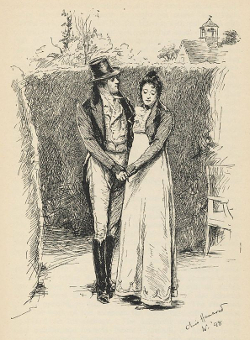
“This gallant young man, who seemed to love without feeling”. Jane Austen, Emma, 1815.
The reader of this passage from Jane Austen’s novel Emma will have experienced this aliveness of language after having finished and digested the book. In his daily life, he will encounter any of the signifiers contained in, for example, the passage above, but applied to other realities external to the book*.* When later they see the verb “to love” elsewhere —that is, in another context— the word will not simply denote whatever conventional definition of love he is most intuitively familiar with, but traces of Austen’s depiction of love will be interspersed into the word’s signified meaning.
Although these traces may often be subtle (depending on the level of resonance that the reader finds in his engagement with the book), they will not be inconsequential for several reasons. One such reason involves the aforementioned workings of imagery: the images that the reader incorporates in his imagination by reading this book might not immediately yield clear, verbally articulable meanings that shape whatever representation of love contained in his mind. Yet, they do operate as an undercurrent, influencing their understanding of love through unconscious suggestion.
The second reason is that whatever the proportion of the effect of Austen’s depiction of love is on the reader’s signified of love, these traces serve as seeds for future encounters with other literary works. What begins as a collection of subtle impressions, details and intuitions about love gained from reading Emma can set the direction for other literary depictions that will build upon them. In this way, the reader’s mind will have been opened and left in a state of receptivity that heightens the elasticity of their signifieds.
The idea of love that Austen develops through her narrative takes shape within the context of how she relates the story’s events (her storytelling), and how she portrays her characters, the world they inhabit, their perceptions of it, and, most significantly, their interpersonal relations. The resulting understanding of this idea of love, which emerges in the reader’s mind as he progresses through the story, will become part of the signifier “love”’s signified.
And, following this renewal of the word “love” —what those four letters are collectively supposed to evoke in the mind—, the reader’s witnessing of a real world manifestation of what he interprets as love will be conditioned by this signified. It is a signified suffused with Austen’s meticulously crafted portrayal of love within her narrative: a signified straddling the boundaries between an idealising, avid imagination, and a reality observed from a holistic standpoint. Then, how the reader will interpret, decide and behave when faced with this real world manifestation of “love” will become shaped by the enriched meanings acquired through his literary journeys (in words, concepts, personal interpretations, imagery, etc.).
The point of equilibrium where meaning and reality come together

I believe that a ratio exists between how much of the signified is immediately apparent, related to the reality that it is assigned to, and how much remains a potential not yet existent in the reality it currently refers to.
There is a point of equilibrium between these two coordinates, where the signified is faithful enough to immediately apparent reality (e.g., the reader justifiably characterises his relationship with his partner as a “loving one”), while the potential yet currently inexistent qualities of that reality (a love containing the depth and fruitful self-awareness found in Jane Austen’s depictions) can manifest itself given the constraints of what is possible in the present moment.
In other words, this equilibrium of literary alchemy concerns a signified that is representative enough of its assigned reality, so as not to be so distant it as to simply become inaccurate, while containing unrealised potentials within that reality that are possible but have not yet manifested for various reasons. For instance, the signifieds conventionally attached to it may be too narrow and restrictive, preventing people from recognising the presence of these potentials.
It is an equilibrium where reality adapts itself subtly toward the signified, while the signified reciprocally moves toward reality. Of course, this represents just another way of modifying the reality around us, just as simple action with a purpose accomplishes through other means. Nonetheless, this semantic operation that revitalises language and renews the inner world of its readers remains uniquely characteristic of literature.
“I have forgotten the books I have read, and so I have the dinners I have eaten; but they both helped make me.” Attributed to Ralph Waldo Emerson.
✵
Leave a Reply