
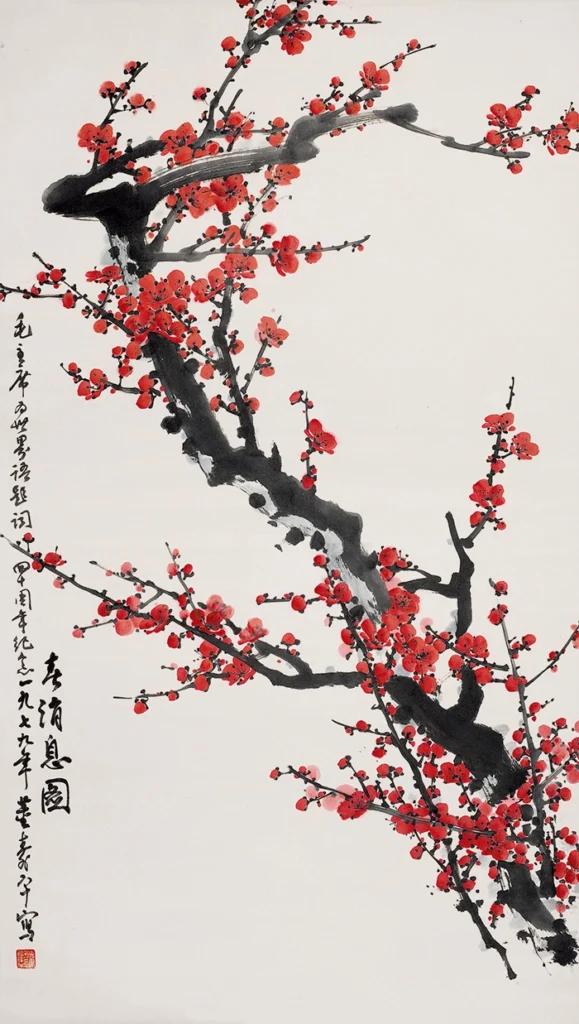
Dong Shouping – Harbinger of Dawn
And in the midst of this wide quietness
A rosy sanctuary will I dress
With the wreath’d trellis of a working brain,
With buds, and bells, and stars without a nameJohn Keats, Ode to Psyche, 1819
We familiarise ourselves and become intimate with a particular branch of knowledge or practice. We pursue it by involving ourselves with it through raw effort, trying to come to new understandings all by ourselves. We get stuck, run into dead ends, watching our hard-built conjectures and conclusions crumble by the occasional spontaneous revelation which arrives to supplant their complexity with simplicity.
It is this familiarity, the joys and pains, the selecting, discarding, meandering that we went through that creates the tree of knowledge and experiences of our own engagement with that particular knowledge or practice (or more simply said, a quest in the sense of a long search).
The tree grows into its own unique shape, rich with decorations, mysterious corners, bends, unexpected superpositions, flowers of whim, hanging vines. It is a tree that began with the seed of an irresistible curiosity, a vital energy pushing us towards a search and an involvement, and from our first forays the roots of our particular approach to it begin to sprout, conditioning the directions our development will take. Then gradually a solid trunk grows as the heart of our search —the recurrent aspects we find the most important, thrilling and worth committing to—, followed by the branches of our own developing ideas and particular details that we follow further. At the same time there appear leaves, flowers, and the fruits of our search (the sweet nectar we offer to others).
And it all continues developing: roots spread further, the trunk grows, its bark’s texture roughens and deepens; new branches sprout from both the trunk and older branches; flowers bloom, decay and bloom again, and so on.
The tree is the path we took towards making a knowledge and/or practice a part of us. It is perhaps slower and more arduous than simpler paths, described within precise recipes, towards a particular goal that we could have taken. Yet, the hardening of foundations that comes from having wrestled with our ignorance and occasional disorientation, the particular detours we unwittingly took that ultimately led to complementary knowledge that gives our approach its own singular brand, and the continuous blossoming of discoveries and creations that takes place as we advance, they are all what makes the path ours.
We got to the “end” (we could call it “mastery”, or “readiness for outwardly contribution in the world) much slower because we found these unique answers by ourselves. No shortcuts exist or are necessary when forging such a path, because the very nature of this path as a “means” to get to an “end”, is that to get to the “end” we need to learn to love the path as if it were a homeland, a sacred tree we embellish and festoon with beautiful garlands, bells, and lights (or as Keats puts it in the poem cited at this text’s beginning: “a rosy sanctuary… the wreathed trellis of a working brain, with buds, and bells, and stars without a name”)
In the end, the tree grew into a unique sight as we internalised an grappled with every detail in our own way, bathing it with our subjective content in a reciprocal symbiotic development (because ultimately we humans are beings of knowledge: we cannot help creating, perceiving and living through knowledge —in a sense, we are knowledge and knowledge is us).
It is beautiful to love the path we take towards a particular search. Certainly, the unique shape of its growth while it becomes a guiding force within us is all a reward in itself. It becomes a part of our identity, and its ripening fruits our gifts to others.
In The Little Prince by Antoine de Saint-Exupéry, this often undervalued type of loving relationship with the world that we humans are capable of is perfectly encapsulated in the image of a rose and the little prince’s love for it, even if an outside observer would say that it is just a rose like any other.
.” . . It’s the time that you spent on your rose that makes your rose so important. . . . You become responsible for what you’ve tamed. You’re responsible for your rose. . . .”
“ Of course, an ordinary passerby would think my rose looked just like you. But my rose, all on her own, is more important than all of you together, since she’s the one I’ve watered. Since she’s the one I put under glass, since she’s the one I sheltered behind the screen. Since she’s the one for whom I killed the caterpillars (except the two or three butterflies). Since she’s the one I listened to when she complained, or when she boasted, or even sometimes when she said nothing at all. Since she’s my rose.”
Antoine de Saint-Exupéry, The Little Prince, 1943
✵
Leave a Reply