
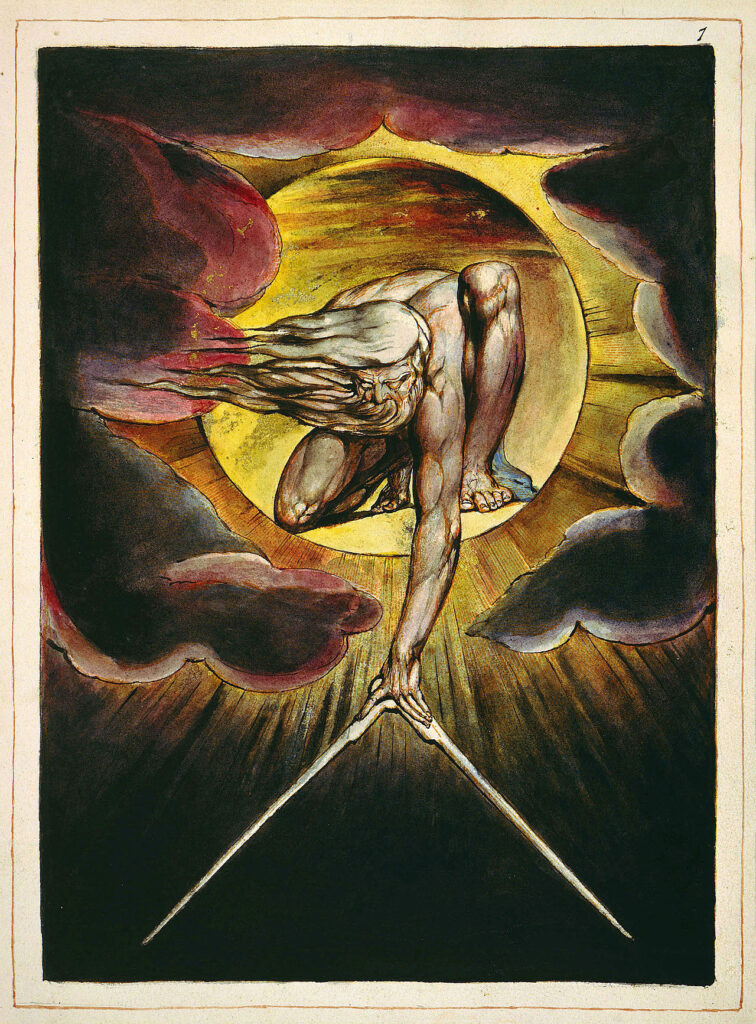
William Blake – The Ancient of Days, 1794
A great many cosmogonies (myths relating the origin of the universe) begin with a variation of the statement “First, there was chaos”.
Greek, Roman, Egyptian, Mesopotamian, Chinese, Shintoist Japanese, Hindu, Aztec, and Norse, are some of the mythologies that explain the beginning of the universe with the act of triggering an initial ordering of a primordial chaos.
Chaos is usually depicted as a formlessness, an undifferentiated watery mass, or an empty abyss where there isn’t either being nor non-being. The first gods are the ones who bring order to this chaos, separating it into its fundamental oppositions such as the Yin and Yang, darkness and light, or sky and earth.
This act of ordering performed by the oldest gods, such as the Egyptian Ra, the Babylonian Marduk, or the Chinese Pangu. Even the Judeo-Christian god does something similar when creating light from darkness, then naming things and ordering them.
Other mythologies also depict the process of things acquiring their own distinct identity, such as Greek titans and gods representing things with increasing specificity which emerge from the interbreeding of primordial beings (night, time, dreams, sun, moon, dawn, discord, memory, foresight), eventually resulting in the Olympian gods such as Zeus and Hera who represent more dynamic and complex amalgamations of concepts; for example, just as Zeus is master of sky, thunder, and lightning, he is also god of justice, law, hospitality, and honor.
In these ancient cosmogonies the theme of the universe emerging from chaos through the definition of opposites, then the emergence of further distinctions, and the establishment of a kind of order among them, reappears over and over again (although certainly with many specific variations belonging to each tradition).
I see the act of creating culture as mirroring the mythical creation of the universe. From the chaos that inevitably regenerates with every historical cycle (for example, deep crises of existential meaning, of both individual and collective purpose, or of political consensus), a new cultural cosmogonic process begins. Such as with primordial myths, it is a process of definition of great opposites, followed by further distinctions, then by putting things together and naming them (or naming what was hitherto unnamed but the times required its identification), and finally organising them in some kind of coherent and dynamic order. 1
The difference with myths of divine creation is that cultural cosmogonies -as a new act of necessary creation in the face of regenerated chaos- belongs to the realm of human choice. When it comes to the gods -if we were to take them as metaphorical entities-, their order is that of objective natural phenomena, where a chemical element is that element and none other, and where the mathematical laws of physics and chemistry (the laws of nature) govern phenomena. They function like an organic, infinitely complex and dynamic machinery whose fundaments are wholly independent from the realm of human will.
Conversely, cultural creation establishes oppositions and distinctions according to a mysterious compound of ethical necessity, human yearnings, imagination, love, ideals, potentials, limitations, and choices. It responds to the nature of past cultural orders that responded to previous states of chaos, while it reacts to the current chaos it tasks itself to separate, define, and organise, driven by this mysterious compound. Maintaining the cosmogonic tenor of this text, I call this compound the divine creative spark we all have within us: a form of intellect that entwines itself with the pulsing desires of our spirits and the larger scheme of things of which we are a part of.
In times of chaos, of uncertainty, weathered past distinctions falter and fray along with the coherent order they shared with others, and new distinctions are bursting through the old walls, ready to be defined and named. In these times, the human creative spark needs to apply itself once again, full of hope that order can be achieved once more, and engage in the same cosmogonic cycle of creation.
Only in this way what needs to be united can become intelligible as a cultural concept, and what needs to be organised into a larger order can be given a role within it, so that it can exert its potential through human action, which has always been guided by the cultural elements that it has incorporated.
After all, we are part of nature as well, and thus human creation follows similar rules. The salient difference is that we possess an ever dynamic will and a capacity to imagine and make reality out of the contents of our minds and hearts. Our realm is the realm of ideation and choice. We are able, within our human limits, to envision new ways of living alone and together, and with this desire guide our choices in extracting from undifferentiated chaos -atomised, fragmented, fluid, deprived of overarching meaning- new things (or renewed old things) that are immanent within it. Then, still guided by our vision, or the desire that draws us towards the horizon of that yet undefined vision, we bestow collective meaning upon these new cultural forms so that they support, complement, or counterbalance each other so that they tend towards unity, intelligible identity, communicability, compatibility, fertility, and purpose.
It is a tendency towards unity that struggles to replace states of chaotic ambiguity, blurry boundaries, disparate fragmentation (split into pieces that no longer fit together), incoherence, and purposelessness. Chaos is a state of disunity, where growing dysfunction among elements losing definition in their conceptual identities pushes things towards fragmentation and isolated incompatibility.
In fact, the very mythical cosmogonies that I have enumerated in the beginning are themselves a hybrid between a product of cultural creation and of observing the patterns of the known universe. It is a retroactive attempt to trace the origins of the discerning, unifying, defining, and organising the immanent possibilities within undifferentiated chaos.
And it always begins with an initial act of differentiation, an initial act of will, a piercing stab into the total sameness of chaos. In cosmogony, this primordial rupture triggers the cascading process of distinction of the fundamental elements of the universe.
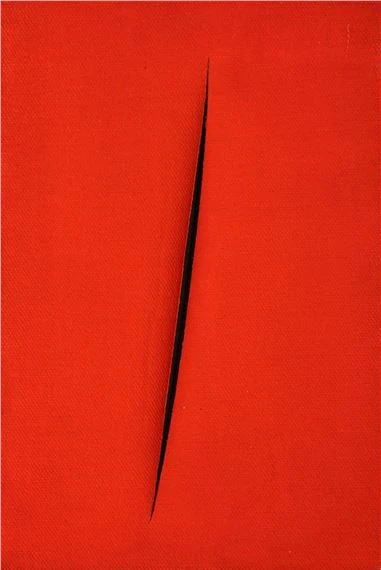
Lucio Fontana – Concetto spaziale, Attese, late 1950s.
✵
- The ancient Chinese doctrine of the Mandate of Heaven reflects these parallels between cosmological developments and political order. In this cyclical view of history, a ruler loses the Mandate of Heaven -and therefore their divine right to rule- when chaos engulfs China in the form of cosmic disorder, through both natural disaster and acute social strife. The new dynasty that rises during this fall is the one that resets the cycle, by once again building a new order from this chaos. ↩︎
Leave a Reply