
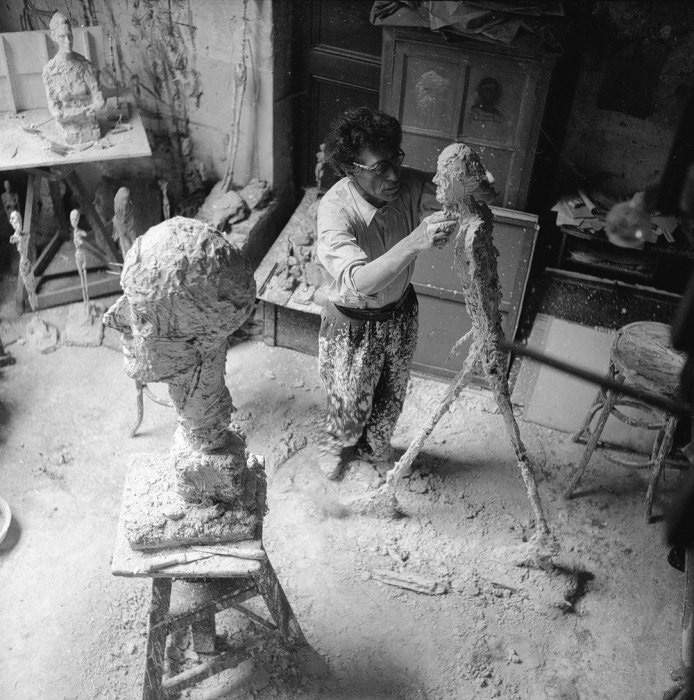
Sculptor Alberto Giacometti at his studio, 1958.
Some implements have been used for certain purposes for a very long time not because they were intrinsically suited for it, but because at the time they were the best at it. They were allocated a purpose that wasn’t necessarily inherent to them, but because they were the best option available. Once something came along that is better at that, the other thing doesn’t simply become obsolete.
Far from it. Ironically, even if some things have been created, assembled, introduced with a certain purpose in mind. This is an allocated purpose. Their essential purpose (or purposes) might remain latent, invisible within the thing’s continuous grappling with its allocated role. It does the best it can, constantly trying to improve in its capacity to fulfil that artificial purpose.
But now it is emancipated. It can be directed towards its essential purpose. It is still the best for doing something, but now that something is more clear and it really exploits its essential qualities. Yes it might seem merely narrowed down and more specific, but beyond that specificity new previously unseen possibilities abound. Essential purposes are what make it what it truly is, what allow it to better persevere in its own intelligible being. And that purpose is extremely interesting because it is unique. And it is new, because it was never isolated in this particular way.
Now, the thing’s other burdens have been taken up by more capable technologies, techniques, disciplines, etc. relative to the fronts where it had rather been a subpar, “best with what we currently got” solution. So the thing can explore great new avenues for which it had previously been barred, having been continuously spread too thin with too many responsibilities.
A canonical example of this phenomenon is painting at the time where photography became widespread and rapidly evolving towards an horizon of the perfect snapshot of a moment. This is when Impressionism and the Modernist movement that it seeded began to lift off, opening multiple thrilling horizons that had been unconceivable before. And it was not because of an impossibility1, but because painting had been forced to fulfil a necessary role for which there weren’t other alternatives: that of visually documenting (and figuratively, and accurately) preserving scenes from reality, literature, and history.
In fact, the new avenues of conceptual exploration that the emancipation of painting from roles for which it was subpar (compared to the technical solutions that came after) opened, transcend the practice of painting itself. They confronted artists with questions about what perception is, what abstract form can communicate when stripped of real figuration, what the true flow and shape of things is beyond what we see from a single perspective from a fixed point in space and time, what the essential structure of reality is, what art is for, and the list continues, encompassing the end of the 19th century and beyond.
Nowadays, technical solutions are repeatedly putting into question things that were supposed to irreplaceably be the best at what they were made to do (or were uniquely equipped to do, such as humans with writing or, once more, graphic disciplines). If the rise of Modernism can easily be considered a thrilling, flourishing, highly generative episode in human civilisation, with the rich successive currents of ideas and practices that it generated or indirectly conditioned, then we can look at today’s looming changes as another period of emancipations and overcoming our blindness of what things can do. In other words, we get to explore the particular essential purposes (already articulated, or yet to be disclosed) that what we already have can do better than anything. We can discover and explore the latent potentials of all that we love but is being demoted (or rather liberated) from its current roles. If we choose so, we can tread new untraversed paths towards previously unseen horizons. For example, now that the “growth efficiency” part of many things has become obsolete, we can explore what those things are actually capable of when emancipated from that burden.
And of course this includes the human soul. There is no doubt that it has repeatedly been forced to learn and engage in things that weren’t intrinsically good for it, nor virtuous. It was rather from a lack of a better solution at the time. Now it can participate in any of these “obsolete” solutions (obsolete only regarding solutions for certain things they were the best solution for before, not obsolete in any of their other aspects) from an exploratory stance, since by benchmarks like “efficiency” or “measurable growth” it is pointless to force them forward.
So we participate in the obsolete solutions just as it happened and keeps happening with painting. We appreciating and further discover its essence, and we choose how to engage with it. It might even become measurable efficient (if that’s the desire) for new, yet to articulate purposes. For example, there has been a reappreciation of painting’s ability to record reality with its own unique contributions both to the product itself, and to the painter’s own inner richness, while sacrificing the speediness and perfect accuracy of newer technologies. Other ancient art forms like theatre have also brought out virtues inherent to them that had been previously demoted as “not what is essential to it”, just as the feeling of being among people in a real, physical environment, or the social ritual aspect of it. And perhaps by opening new horizons, the very concept evolves towards ways that potentiate these and allow them to further develop in powerful ways.
And this happens because at some point theatre had been spread too thin to fulfil requirements of spectacle, of story-telling, of the script being performed and the fiction on the stage being at the centre of this phenomenon. Once other forms such as cinema, audiovisual content, videogames, virtual reality, etc. began to crowd that particular lane (and also those of personal or urban entertainment, or, if we travel back further in time, the Aristotelian idea of the ultimate cathartic art form), then what was unique to theatre began to be put into question, and from that pressure new unseen articulations emerge.
Specificities of what things have to offer (things like what has been with us for very long, and what is now emerging) are being narrowed down. And this is not simply a process of limiting what something can do, of specialising it further. It is a wholly generative phenomenon. This is because, at the same time, new horizons are slowly revealing themselves to us. And it’s a matter of turning towards them and slowly letting go of our justified worries, our justified disorientation, to let the thrill awaiting beneath it dawn upon us.
Lest it devolves into a blinding obstinacy, born from latching on to something that isn’t working anymore, something that was born through the very same process of making something else “obsolete” and now might be begging for purpose reallocation. For them to be born and support the lives we live, our predecessors had to eventually let go of their own familiar solutions.
✵
- Any painter since ancient times could have decided to follow the conceptual paths of Impressionism. It might have been less accessible to paint “en plein-air” and the use of greater palettes thanks to the introduction of synthetic paintings, but if someone deemed it worthwhile and the societal structure of its time allowed it, they could have explored these questions. ↩︎
Leave a Reply