
⚘Branch thought from Creating from the Heart is contributing to the Great Spirit of Humanity
⚘ Branches: Abstraction and representation are a snake eating its tail
Table of Contents
- Our human capacity to dream is an essential yet elusive source of much of our activity
- When does art lose its powers and become merely another unevocative object?
- Art is a changing variety of many things at the same time, but not quite entirely any of them
- The tragedy of art sinking into the background as life marches on unchanged
- The conversion of immaterial artistic effects into concrete things in the non-artistic world
- Art renovates its power every time the world transforms to resemble it more
- Art asks us to reproduce the artistic intention so that we dream more and create more art
Our human capacity to dream is an essential yet elusive source of much of our activity
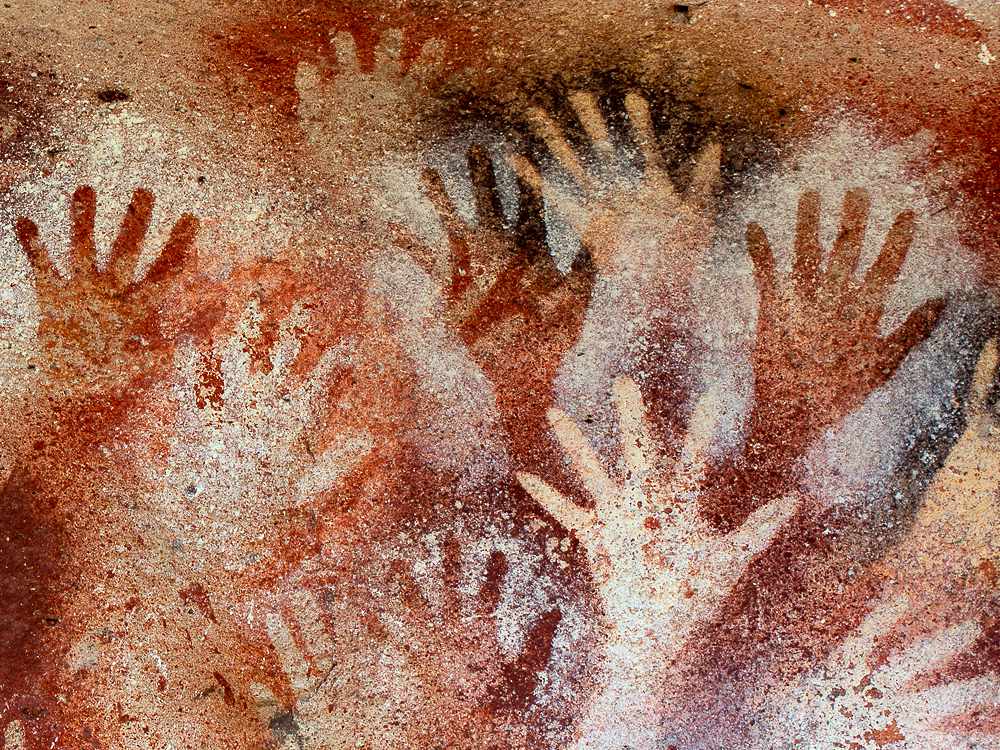
The Cave of Hands is a rock art site located in the province of Santa Cruz, Argentina. Ten thousand years ago, members of a hunter-gatherer group in the area had the idea to stencil their hands’ outlines on the rock walls. This early artistic gesture survives to this day. Seeing these marks is a powerful experience; one wonders how this project came about, who came up with the idea, and how much fun the people involved had doing it.
Beyond that, we realise that this ‘hunter-gatherer group’ was above all a group of people just like any other. The fact that seeing this piece of art invokes that acute realisation of their humanity -their status as subjective beings with rich inner lives such as us- tells us how essential the act of making art is to being human: having produced this seemingly whimsical piece of art becomes proof of their richly subjective humanity. No subjectivity is more human than that which can lead our creative drive to the most unexpected, impractical, yet vitally nourishing places.
If this then signals proof of humanity -of them deep down being just like us-, then the artistic drive constitutes an essential element of being human; we wouldn’t quite be human without it. We are effectively homo phantasians: dreamers led by the not-yet-existing fantasies in our imagination, which we long to somehow give some kind of material or enduring form in our reality.
When does art lose its powers and become merely another unevocative object?
When does art become decoration, background noise? How long does it take until we become indifferent to a pretty piece of furniture or interior design as it loses its novelty? When does a musical piece turn into merely a means to ‘set a vibe’, keep us focused on a productive task, or calm down our anxiety so that we can refresh our efficiency? When is it reduced merely to its basic elements, its rhythm and sonic palette, and to the neurochemical reaction it generates in us.
One answer emerges when we imagine removing an art piece from our surroundings. What would the world be for those people if they had never made this Cave of Hands? It’s an interesting question. And it’s subtle, as it pertains to these people’s invisible subjectivities, and therefore we can only guess what role the effects of this Cave of Hands played in conditioning their passage through life.
Art is a changing variety of many things at the same time, but not quite entirely any of them
I really think that more than understanding art to learn how to live, we learn how to live in order to understand art ever more deeply. Please note that with the word “art” I’m referring human creation that surpasses single definite categories or areas of life, in the ways that we define and organise them as a society and culture (for example distinctions between types and areas of specialised activities such as a branch in the sciences, professions, or simply categories that organise our daily activities such as leisure, work, hobbies, sports, travel).
They are works that are made from a particular source within the human spirit that is hard to pinpoint, but that we are all capable of feeling its presence. It is a holistic source, in the sense that, led by its mysterious inner laws, it blends elements from our external and internal experience in novel ways to create a new thing: a sum greater than its parts, a work of art.
In essence, art is creation driven by this source, which escapes any single compartment by which we classify the domains of human activity or types of objects. It is thus called “art” not because it belongs to a specific compartment, but because ‘art’ means that it doesn’t quite belong to any compartment, and it is still powerful and we humans can’t help feeling something meaningful when doing it, and we desire for it to exist.
Surely, the Cave of Hands belongs to this “art” type. Some anthropologists might be tempted to call it part of a ‘religious’ practice. Religious is also a tricky category which art can quickly absorb. After all, art is fully compatible with a notion of the sacred and the transcendent, without imperatively requiring a connection to a particular deity or a larger set of collective ‘religious’ beliefs, rituals, and practices.
The tragedy of art sinking into the background as life marches on unchanged
But once we have ventured this negative definition of art (what it isn’t is clearer than what it is, which leaves space for the art object to create its own category if needed, depending on how it will relate to the world around it) and what inspires it (this aforementioned source), the lingering question is: what do we do with it once it’s there, a created existing thing? Is it enough that it is simply an entity of inherently indeterminate utility that needed to exist? Just a pretty thing and-then-we’ll-see? Something with its own little universe that might eventually inspire someone who sees it to do something interesting?
I wonder what those who made the Cave of Hands thought about this: “We did this fun thing. We have this fun memory together, and we can revisit it when we pass by this cave. And the memory will in some way remain for our children and their children”.
I think that there is a tragic side to artistic things. Their magic wears out with time, and the attention we devote to them diminishes as they is drowned by the world of things offering immediate mono-dimensional utility, and of other projects anticipating some ‘concrete’ benefit. I personally feel a yearning for that which lives within the piece of art to somehow percolate into our world, making our world a bit more like what moves us about this art.
But how can that happen, unless it somehow inspires organised collective action set upon transforming the world to be more like this piece of art?
The conversion of immaterial artistic effects into concrete things in the non-artistic world
I don’t know the answer, but I suspect that one way to see it has to do with the conditioning of human behaviour, one of the most transformative forces in the world. There is a kind of transmutation that can take place from a work of art, in which some of their elements (be it visual, descriptive, musical, formal) sublimate into a more abstract form (immaterial and more generally applicable things like ideas, concepts, values, desires) that can then find new expressions in the physical world, be it within “artistic” or “non-artistic” dimensions.
And the more the world is arranged and decorated in “artistic” manners (that is, following aesthetic principles, giving more space, and accentuation to artistic creations, and a stronger, symbiotic incorporation into the mesh of human society) the more these abstract forms will circulate in the minds of people, continuously refreshed in their memories as they are continuously exposed to coherently arranged, and harmoniously assimilated, art.
And thus, the hitherto uncategorised yet beautiful things that art expresses find their way into transforming our reality by being transmuted once more from the abstract to the concrete in our world —ultimately the sequence goes as follows: first the concrete in the imaginary world of art (such as a beautiful scene or dramatic climax in a novel); then, this translates in something abstract (what these scenes represent, what dynamics, attitudes, qualities); then, the abstract circulates in the minds of people and conditions their perception, decisions, and behaviour.
Finally, people transform their reality, either individually or coming together with others, from this heightened state of being (a state that understands value beyond profitability or immediate utility, that looks up to ideals, meaning, and the whims of our hearts).
Art renovates its power every time the world transforms to resemble it more
So in a way art is always guiding us towards reproducing Art in the more universal sense (as a holistic assertion of existence that breaks away from settled conventional categories) in some way or another, but its inner magic charge will only remain and intensify at the price of us assimilating the meaning of its content and translating it in some form to our world.
Action gives power to art. Art retains its magic when it is actively involved in the world’s transformation through human action. It doesn’t need to be action in the political sense of great waves of human organisation and transformation; it can simply mean adopting a mode of existence that is more actively responsive to art.
We do so by translating what moves us from a particular art piece or type of art into other things in the world. We perform this translation through our decisions and behaviours, our creative acts (in the simple sense of making something come into existence), our way of engaging with what is around us and intervening in it, or of communicating with others. As it is translated, it changes its form, and its form infuses what we were translating with new mysterious potentials for meanings: a short story might have been in part inspired by the artistic energy that a beautiful architectural interior generates. We might then be translating the spirit of what moved us from that interior into the story. Yet, the “message” will not be the same; it will have morphed in line with its new vessel’s nature.
Art asks us to reproduce the artistic intention so that we dream more and create more art
In a way, we become conducts that pass on this ineffable yet unquestionably emancipating and beautifying power that art generates into other things in the world, so that it may, little by little, envelop our entire shared reality. We want to shape life in a way that a gesture such as painting our hands in a cave —something nobody among them had done before, something that at the moment had no particular place in the order that governed their daily way of life— does not dilute into meaninglessness. That gesture of transcendence that we humans naturally feel compelled to do is made so that an eventual return to the daily cycles of our lives does not make us forget this: the timeless need to keep forging humanity’s path towards a meaningful and happy existence.
So, what do we do with the Cave of Hands after it’s been finished and life continues? The more we move in the world and transform it (and others) in a way that is faithful to the energy that this piece inspires, the more power the Cave of Hands receives – as its intention of “impractical transcendence” reproduces in new things and these new things themselves reproduce – the more meaning all of them obtain as part of something greater: a more enchanting, starry-eyed, and beautiful existence.
✵
Leave a Reply