There are three qualities that teachers can embody:
Making the journey easier for students in the places where it was next to impossible for themselves: they have forged a difficult path of knowledge acquisition towards a synthesis of their journey. They have internalised this path and, having forged it themselves with the meticulous and involved awareness that this demands, understand it so intimately that they can extract its essential kernels. They wholeheartedly wish that others can move along the same path more quickly. So they pour their efforts into transmitting the most fundamental realisations, accepting that the majority of struggles and details that peppered their own journey might be irrelevant for their students’ own personal path. Ultimately, they transmit this condensed and evocative synthesis of the essential to their students.
Cultivating enthusiastic wonder for the immensity of human knowledge at their disposal: they expose students to what is out there in the field of knowledge that they are teaching, and in universal knowledge in general. They are broadening their awareness of the dizzying amount of sources of answers and questions that are at their disposal, of which they had hitherto been unaware. This exciting prospect of endless possibilities for finding life-changing nuggets of knowledge instils a deeply, viscerally felt love for the ever-increasing freedom that learning produces (learning is in a way the expansion of our Selves through both a more intimate understanding of the world -including other humans- and a nimble familiarity with some of the means through which we can connect with it -again, including other humans and other beings-, transform it, nurture it, and elevate it)
Situating students within a proud quest larger than themselves: they instil an awareness in them that the teacher’s journey and the path they have forged is part of an old search that stretches across time and space. It is a search that they can be a part of, and all those who precede them -carrying the torch and igniting new torches- were simply humans just like them, in all their inadequate yet original quirks, their vulnerability, their sacrifices when going against the current, and their subjection to their own times’ pressures. The teacher instils an awareness of this genealogy, showing the students that they would become part of a group engaged in a great timeless quest, and that honouring those who came before will also solidify an unshakeable source of pride within them.
This all is so students will sense and dare to venture into uncharted areas that emerge from their teachers’ path of knowledge, while protecting the tradition that they are committed to. And armed by their teacher’s inherited love for knowledge, they forge and synthesise their own paths for the next generations.
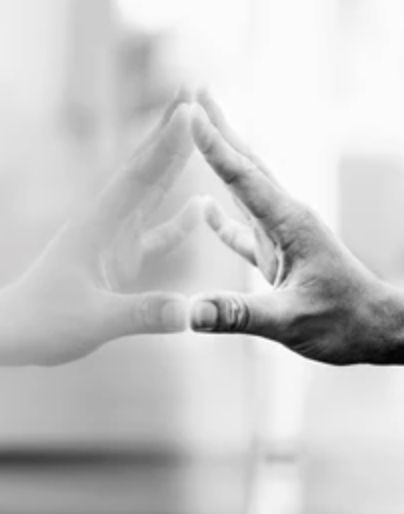
Alienation is walking through the corridors of life while witnessing the world through a clear glass wall. It stands between ourselves and everyone else, preventing us from engaging with the other from our authentic selves1. It is a glass pierced with a few little holes, each hole has its own shape and this defines what kinds of messages we can send through them, the options by which we can engage with others.
And the glass is transparent because we see that there is much more than what the little holes allow us to engage with. We see everything else worth engaging with, pointing out, digging into, supporting, or helping cultivate and come out in to the world. Yet all of this is of secondary importance, fit to be waved away, because it is too risky, confusing, messy and seemingly away from the carefully signalled path that we think we are walking. Led astray from this path, we fear we will fall through the cracks of unknown untrodden territories, relinquishing a possibilities of enduring material peace, pride in our stability within a social role, and emancipation from existential concerns.
Some -probably most people at some point in their lives- have tried otherwise. They have banged at the glass, tried breaking it, jumping over it, but it hasn’t worked. So they give up in frustration, or they lose hope in how much they will be able to endure from the mortification that comes from misunderstandings and rejections produced by getting too creative with the glass. They even lose hope on whether it is even possible to live in some other way than mediated by the little holes in the glass.
Thus, we are alienated. They will only notice us and react accordingly when we send our messages through one of the little holes. In a sense we are little more than what filtrates through the holes. Our authentic selves become estranged from others (and their own authentic selves). They even become estranged from themselves, as they become skeptical of their very own existence, lacking an essentially needed external recognition from other minds.
Alienated from ourselves and others, we walk the corridors in the same manner, deftly “taking care of things” and “solving problems”, as we offer and receive what’s needed through the few little holes pierced through the glass’ surface. It’s enough to survive and find pockets of satisfaction.
Some become fascinated by the little holes; others bang at the glass, or try to shove messages through. Unfortunately, they do not match the holes’ shapes, so they see them fall to the other side all wrinkled up, battered, ugly, and suspicious-looking. Then, others somehow find other people who also distrust the glass and see them through it, not minding the little holes. These ones find a way to drill some more holes with their own special shapes in the glass between them, to feel less alone in their own glass-walled corridors.
How much of this glass is from our own personal making? How much do we contribute to its hegemony? And how much of it is to blame to the “system”, the “culture”, or “them”? It’s hard to know, probably a bit of everything. Yet, the feeling is very real and worth describing with honesty. Something tricky about alienation is that being such a slippery (just like the glass itself), bewildering phenomenon needing some cause to take the blame, it can easily develop into self-hatred, or into its counterpart of bitterness with the world.
Authentic self is the one that remains when all masks are off, in the middle of the night when we are left with the self behind all expectations. It is the one that flourishes from our innermost proclivities, feelings, thoughts, and dreams that fill us with zest. They are all linearly sourced from our hearts, away from the social games we play in daylight. ↩︎
Our human capacity to dream is an essential yet elusive source of much of our activity
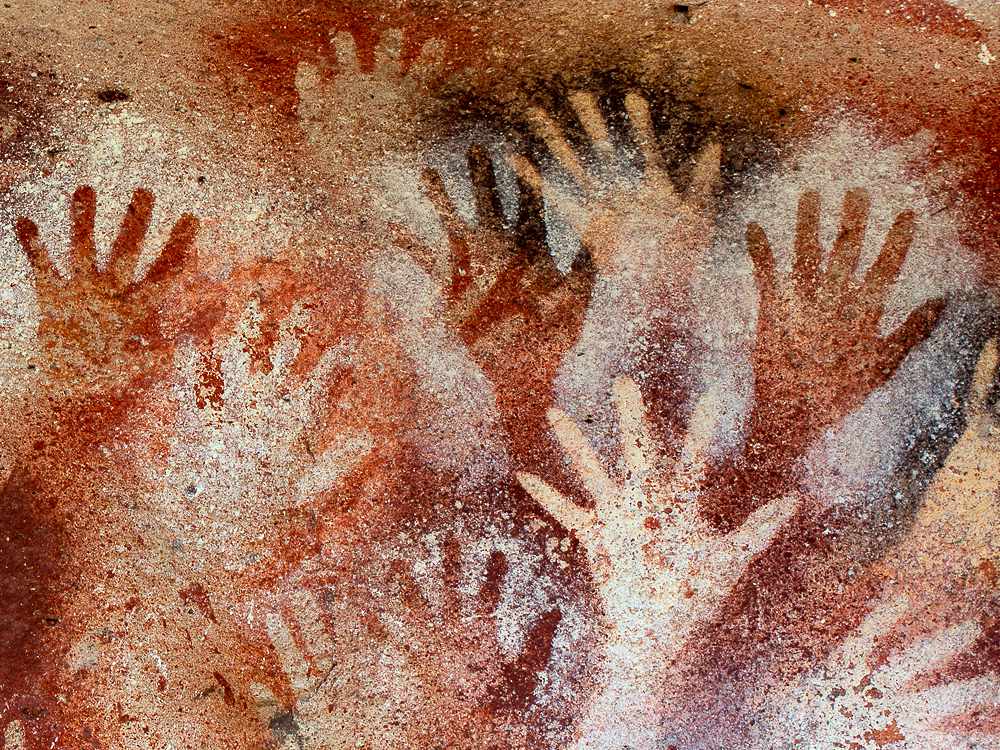
The Cave of Hands is a rock art site located in the province of Santa Cruz, Argentina. Ten thousand years ago, members of a hunter-gatherer group in the area had the idea to stencil their hands’ outlines on the rock walls. This early artistic gesture survives to this day. Seeing these marks is a powerful experience; one wonders how this project came about, who came up with the idea, and how much fun the people involved had doing it.
Beyond that, we realise that this ‘hunter-gatherer group’ was above all a group of people just like any other. The fact that seeing this piece of art invokes that acute realisation of their humanity -their status as subjective beings with rich inner lives such as us- tells us how essential the act of making art is to being human: having produced this seemingly whimsical piece of art becomes proof of their richly subjective humanity. No subjectivity is more human than that which can lead our creative drive to the most unexpected, impractical, yet vitally nourishing places.
If this then signals proof of humanity -of them deep down being just like us-, then the artistic drive constitutes an essential element of being human; we wouldn’t quite be human without it. We are effectively homo phantasians: dreamers led by the not-yet-existing fantasies in our imagination, which we long to somehow give some kind of material or enduring form in our reality.
When does art lose its powers and become merely another unevocative object?
When does art become decoration, background noise? How long does it take until we become indifferent to a pretty piece of furniture or interior design as it loses its novelty? When does a musical piece turn into merely a means to ‘set a vibe’, keep us focused on a productive task, or calm down our anxiety so that we can refresh our efficiency? When is it reduced merely to its basic elements, its rhythm and sonic palette, and to the neurochemical reaction it generates in us.
One answer emerges when we imagine removing an art piece from our surroundings. What would the world be for those people if they had never made this Cave of Hands? It’s an interesting question. And it’s subtle, as it pertains to these people’s invisible subjectivities, and therefore we can only guess what role the effects of this Cave of Hands played in conditioning their passage through life.
Art is a changing variety of many things at the same time, but not quite entirely any of them
I really think that more than understanding art to learn how to live, we learn how to live in order to understand art ever more deeply. Please note that with the word “art” I’m referring human creation that surpasses single definite categories or areas of life, in the ways that we define and organise them as a society and culture (for example distinctions between types and areas of specialised activities such as a branch in the sciences, professions, or simply categories that organise our daily activities such as leisure, work, hobbies, sports, travel).
They are works that are made from a particular source within the human spirit that is hard to pinpoint, but that we are all capable of feeling its presence. It is a holisticsource, in the sense that, led by its mysterious inner laws, it blends elements from our external and internal experience in novel ways to create a new thing: a sum greater than its parts, a work of art.
In essence, art is creation driven by this source, which escapes any single compartment by which we classify the domains of human activity or types of objects. It is thus called “art” not because it belongs to a specific compartment, but because ‘art’ means that it doesn’t quite belong to any compartment, and it is still powerful and we humans can’t help feeling something meaningful when doing it, and we desire for it to exist.
Surely, the Cave of Hands belongs to this “art” type. Some anthropologists might be tempted to call it part of a ‘religious’ practice. Religious is also a tricky category which art can quickly absorb. After all, art is fully compatible with a notion of the sacred and the transcendent, without imperatively requiring a connection to a particular deity or a larger set of collective ‘religious’ beliefs, rituals, and practices.
The tragedy of art sinking into the background as life marches on unchanged
But once we have ventured this negative definition of art (what it isn’t is clearer than what it is, which leaves space for the art object to create its own category if needed, depending on how it will relate to the world around it) and what inspires it (this aforementioned source), the lingering question is: what do we do with it once it’s there, a created existing thing? Is it enough that it is simply an entity of inherently indeterminate utility that needed to exist? Just a pretty thing and-then-we’ll-see? Something with its own little universe that might eventually inspire someone who sees it to do something interesting?
I wonder what those who made the Cave of Hands thought about this: “We did this fun thing. We have this fun memory together, and we can revisit it when we pass by this cave. And the memory will in some way remain for our children and their children”.
I think that there is a tragic side to artistic things. Their magic wears out with time, and the attention we devote to them diminishes as they is drowned by the world of things offering immediate mono-dimensional utility, and of other projects anticipating some ‘concrete’ benefit. I personally feel a yearning for that which lives within the piece of art to somehow percolate into our world, making our world a bit more like what moves us about this art.
But how can that happen, unless it somehow inspires organised collective action set upon transforming the world to be more like this piece of art?
The conversion of immaterial artistic effects into concrete things in the non-artistic world
I don’t know the answer, but I suspect that one way to see it has to do with the conditioning of human behaviour, one of the most transformative forces in the world. There is a kind of transmutation that can take place from a work of art, in which some of their elements (be it visual, descriptive, musical, formal) sublimate into a more abstract form (immaterial and more generally applicable things like ideas, concepts, values, desires) that can then find new expressions in the physical world, be it within “artistic” or “non-artistic” dimensions.
And the more the world is arranged and decorated in “artistic” manners (that is, following aesthetic principles, giving more space, and accentuation to artistic creations, and a stronger, symbiotic incorporation into the mesh of human society) the more these abstract forms will circulate in the minds of people, continuously refreshed in their memories as they are continuously exposed to coherently arranged, and harmoniously assimilated, art.
And thus, the hitherto uncategorised yet beautiful things that art expresses find their way into transforming our reality by being transmuted once more from the abstract to the concrete in our world —ultimately the sequence goes as follows: first the concrete in the imaginary world of art (such as a beautiful scene or dramatic climax in a novel); then, this translates in something abstract (what these scenes represent, what dynamics, attitudes, qualities); then, the abstract circulates in the minds of people and conditions their perception, decisions, and behaviour.
Finally, people transform their reality, either individually or coming together with others, from this heightened state of being (a state that understands value beyond profitability or immediate utility, that looks up to ideals, meaning, and the whims of our hearts).
Art renovates its power every time the world transforms to resemble it more
So in a way art is always guiding us towards reproducing Art in the more universal sense (as a holistic assertion of existence that breaks away from settled conventional categories) in some way or another, but its inner magic charge will only remain and intensify at the price of us assimilating the meaning of its content and translating it in some form to our world.
Action gives power to art. Art retains its magic when it is actively involved in the world’s transformation through human action. It doesn’t need to be action in the political sense of great waves of human organisation and transformation; it can simply mean adopting a mode of existence that is more actively responsive to art.
We do so by translating what moves us from a particular art piece or type of art into other things in the world. We perform this translation through our decisions and behaviours, our creative acts (in the simple sense of making something come into existence), our way of engaging with what is around us and intervening in it, or of communicating with others. As it is translated, it changes its form, and its form infuses what we were translating with new mysterious potentials for meanings: a short story might have been in part inspired by the artistic energy that a beautiful architectural interior generates. We might then be translating the spirit of what moved us from that interior into the story. Yet, the “message” will not be the same; it will have morphed in line with its new vessel’s nature.
Art asks us to reproduce the artistic intention so that we dream more and create more art
In a way, we become conducts that pass on this ineffable yet unquestionably emancipating and beautifying power that art generates into other things in the world, so that it may, little by little, envelop our entire shared reality. We want to shape life in a way that a gesture such as painting our hands in a cave —something nobody among them had done before, something that at the moment had no particular place in the order that governed their daily way of life— does not dilute into meaninglessness. That gesture of transcendence that we humans naturally feel compelled to do is made so that an eventual return to the daily cycles of our lives does not make us forget this: the timeless need to keep forging humanity’s path towards a meaningful and happy existence.
So, what do we do with the Cave of Hands after it’s been finished and life continues? The more we move in the world and transform it (and others) in a way that is faithful to the energy that this piece inspires, the more power the Cave of Hands receives – as its intention of “impractical transcendence” reproduces in new things and these new things themselves reproduce – the more meaning all of them obtain as part of something greater: a more enchanting, starry-eyed, and beautiful existence.
I read that philosopher Derrida distinguished between two ways of thinking about the future: the future and l’avenir (French for future).
The future indicates a conceivable point in time in the future; for example a point that we have scheduled for a particular date. On the other hand, l’avenir refers to the continuous movement of events unfolding into the present without any ability to foresee their arrival (in fact, events would rather be coming into the present, as avenir contains the idea of venir, which is to come – it is what is to come).
Some may call these distinctions over-intellectualised nitpicking. Perhaps this is true, but that’s one of philosophy’s purpose: as long as it represents an honest intellectual effort, then it is fair game. After all, it doesn’t hurt anyone to stop taking for granted the word future in order to carefully dissect it.
I think that in the realm of immediate “real world utility” for a reader detached from the finer details of these debates, this distinction is simply an excuse to make us to pick out and explore another way of thinking about what “future” means. In what amounts to a dialectical device, the distinction enriches our perception of both ideas; the concept of avenir becomes part of the notion of future, and the notion of future becomes part of the concept of avenir.
In every day application, there is no schism between a concept of avenir and that of future. Few people really care. These words go back to being no more than synonyms of each other. In every day language avenir simply remains the French word for future, no more and no less.
After the distinction has been made between what is unfolding -or coming- and what is in some fixed point in the future, both pieces are absorbed back into the single concept of future.
That is the great utility of such nitpicking. Those who understood the explanation have now integrated into their concept of future a new mental model on top of the previous one. And better still, by sticking with such an intellectual exercise, they will have developed a clearer awareness of how hazy their previously intuitive and utilitarian understanding of the term was, and how in its newfound complexity it harbours new possibilities to think about such a permanent thing in our existence as the passing of time.
So go ahead, there’s no need to feel pressured to learn all the concepts born from these sharp dissections of phenomena. You can just as well enjoy the ride, forget the concepts’ names, and see how your ability to think about it, and the world in general, expands in enriching ways.
I envision the passing of history neither as being wholly cyclic or wholly linear. I envision it as a process of a growing garden where present and past overlap.
Some seeds of the recent past begin to flourish in the present until they overtake it. At one point what once was a thrilling beauty of their flowers becomes an all-consuming plague. At this point a protective reaction emerges from both the rest of the garden and new seeds flourishing
The rest of the garden struggles for its survival, so that the harmony in its variety perseveres; in this fight against the plague it bolsters its strongest specimens while sacrificing those who are superfluous. Meanwhile, the new seeds slowly overtake the plague with their juvenile, novel qualities.
Eventually the plague subsides. It shrinks and is absorbed by the garden’s luxuriant living forces. It finds it harmony with the rest of the garden’s specimens and its own place in it. From now on, it will flourish in its own thrilling and humbled way, creating new beautiful arrangements with the other plants, many having gone through this youthful process and many times having joined the struggle to protect the garden’s integrity while renewing themselves.
And so, while the time’s novel specimen begins to thrive in its initial fascination and become its own plague, what was universal finds its place in the gardens of overlapped past and present, developing its niche in ways that perhaps are infinitely more thrilling than what was possible during its supremacy.
Or perhaps this is rather an ideal condition that doesn’t acknowledge other tendencies of history: the old becomes obsolete and abandoned, its growth stumped as it loses universality. Meanwhile the new all-encompassing, taken as matter of fact, becomes homogenising, and amnesia-inducing, until it itself is stumped by the next wave of “progress”.
Continuous problem-solving and optimisation, and fulfilling wishes and needs until they re-emerge (or new ones appear) creates a feeling of a perpetual present; a feeling of time rushing forward as the contents of time past seem to merge into a homogeneous mass of sameness with slight variations and few spikes of exceptional things taking place (in some cases only punctuated by consumption: the purchase of something new -the alchemic transformation of money into a finished object to which we only relate through acquisition and utilisation- that would illusorily break this repetition)
In the day-to-day of the perpetual present there is no perceivable change. Except for a vague gradual advancement of the chain of causality, of cause and consequence, that somehow makes today different in some sense than 5 years ago. However, that change is dissatisfactory; we are powerless confronted to this chain of causality, where our role belongs to the daily satisfaction of needs, as they go and then emerge once again.
Many of these needs and wishes soon resurface as the cycle shortens. The spiritual need is totalised into the summoning of neurotransmitters: the results (or dare we say “impacts”) of fulfilling a need become secondary to obtaining our due of momentary serotonin-powered peace. The results are acceptable as long as they do not disrupt the security that we have pieced together for ourselves, our homely status quo ensuring decent survival. And this cycle of surfacing and fulfilment continues, making hopeful and hard work towards something meaningful but risky seemingly impossible; we perceive ourselves as weak, we lose faith in our agency.
We want to be kind to ourselves and solve problems just to get a bit more of that peace and security. We ignore the angst-inducing (an angst we prefer to suppress and not bring up) inner void, a subtle spiritual hunger that we stopped even trying to fulfil. We prefer this hazy neurotransmitter powered peace so that we can be functional enough to fulfil our responsibilities to society. Without change and an act of intrinsic personal (or group, or communal) agency and meaning, the present is a cyclic eternity.
But we humans, it is in our nature that we fall in love with forms. We cannot explain it, transcending any idea of utility, profit or rational justifiability. We might call this our hopeful star, that we see when we are faced with infinity, when the inner chatter that we impose into our minds ceases (our masks fall off sometimes: we read a passage in a book, we shiver at a scene in a film, a musical piece, a beautiful house or a garden, at the sudden surge of “useless” empathy we feel for a fellow stranger, at witnessing an act of excellence or heroism).
Everyone chases or has toyed with the idea of chasing these forms, because it is in our nature. They express some strange loyalty and unconditional cherishing that we deeply feel in our core: like a gravitational force, or an unfailing tugging at our sleeves, reminding us that it is there and will always be there no matter how much we shove it aside as “childish” or “unrealistic”, no matter the complexity and meticulous coherence of the scaffolds of social appropriateness we have built around our identities.
They are forms because words cannot express them. Words are conventions; they are built upon mutual understandings of experiences because they are made to communicate between people. But that source of hope1 and yearning that we all carry is individual to us, only we can know it to the core, as we see it expressed in different forms in the world (a metaphor, a genre, a lifestyle, a particular scene of life, a type of clothing, a type of object or activity).
In the end, the only word that could really explain this yearning is your name, “you”. And only a friend, someone with whom you formed a true spiritual bond, will know what “you” means, otherwise there are no combinations of words that will do it justice.
Words cannot express it, but we yearn to give these forms more space in the world, creating that change that disrupts the eternal present while it brings us closer to these forms, to understanding them and thus understanding ourselves better.
I suspect that in this path towards becoming a hopeful being, chasing and creating these forms that transcend the eternal present fills that void. We disrupt an eternal present because we believe full with hope that there lies something better beyond it, where we live by these forms. We cultivate, create, share them, and inspire them in others, so that this witnessing can also bring some of this hope in others: that trying to understand what moves us and gives us life is a worthwhile pursuit, even if we cannot quite explain why it moves us to others.
Credit to Byung-Chul Han in his books The Spirit of Hope for providing an explanation of Hope the most truthful I have come across so far. ↩︎