“So whatever it is we experience, we have to express in language that is just not up to the occasion.
That’s it! That’s what poetry is for. Poetry is a language that has to be penetrated. It doesn’t shut you off, it opens. It’s the rhythm, the precise choice of words that will have implications and suggestions that go past the word.”
Joseph Campbell in Joseph Campbell and the Power of Myth, 1988.
People with a natural bent towards poetry are those whose thoughts are constantly suffused by the ineffable (what available words fail to convey), to the detriment of what can be said with words.
What can easily be said becomes accessory to them. It becomes a performance, a game, while the ineffable that wells up within them through their experiences in the world is what they truly engage with when they really try to communicate. In this sense, authentic expression happens when they try to convey something through words as faithfully to that pure, experience as they are able to. It is that stage of assimilating an experience before we put conventional words in it, a process which inevitably curtails its true richness as it becomes distilled through the narrowing, pre-established definitions of conventional language in its most utilitarian sense.
Their inner selves -call it their psyche, their soul, or their minds: their inner subjective processes of imagination, feeling, instinct and thought- confer an unusual predominance on things in the world that have not yet been put into words (or at least properly).
So, when those who are innately poetic endeavour to communicate the ineffable (what at the moment cannot be put into words, or perhaps never will be), they will attempt to conjure the most faithful combination of words, structure, and rhythm that their inspiration will allow them.
This combination will work not in terms of the words’ combined definitions complementing each other, but in terms of the unique imagery this totality evokes and the state of transformed perception that the reader could reach by engaging with it. In a way, the poet crafts a combination of words that, instead of telling what something is, it makes the reader experience it in a heightened, enchanted manner; it reveals it to us and points our attention to it.
An innate poet’s advantage lies in that the richness of that pre-verbal manifestation of experience remains palpitatingly strong within them, granting them a sharper instinct for crafting a medium for its expression. However, their disadvantage is that the ineffable claims an impractically large portion of their mind space, at the expense of the expediency granted by what can already be easily said with words.
The result is a less efficient engagement with reality, especially when it is a language-centric social reality where speaking is the primary means of participation in the human world. In the poetically inclined, the ineffable radiates within, instilling a compelling sense of its call to be given expression in the world (and to be communicated to others). They are highly sensitive to the importance of the unsaid, even when it hasn’t yet been culturally acknowledged enough to be given conventional expression. And they carry the daring intuition that they can give form and life to what has not yet been spoken.
Were they to continually suppress this inclination in favour of the already spoken, it would remain a draining thorn in their side: born of both a deep sense of waste of what they feel to be essentially important and beautiful, and of the constant waste of energy in resisting the currents of their innate attunements.
Poets do not codify anything in the world. That is the pursuit of many other great disciplines. A poet’s words can only gently guide our gaze and hearts towards things in the world: unseen beauties, things that are looked at differently, or expressions of captured experiences.
Poets decode nature (the world, the universe) in order to codify the human soul. But the human soul is impossible to codify conclusively; this is why poetry offers no definitions, only invitations to particular transformed states of existing, perceiving, moving towards certain things, and of experiencing.
In the most expansive sense, the poetic is nothing more and nothing less than aiding handholds for the ever-untamed, ineffable parts of the soul.
When humans decided that thinking hard and long was worth it
If we take a step back to contemplate the great history of humanity, it would be fair to say that the emergence of science as a method to understand phenomena and codify these understandings is but one episode under the broader arc of humanity’s great adventure of the mind.
This great adventure consists in our venturing into a more sustained and systematic use of our thinking capabilities.
I evoke the idea of “sustainment” because although we were always capable of thinking, for the greater part of our existence as a thinking species, we seemingly haven’t insisted on thinking further and patiently building knowledge bit by bit when faced with things that were seemingly impossible to understand. To understand this idea, think about this common occurrence in everyone’s daily lives: when you are thinking about something complex, many times you quit that thinking process once you are confronted with a seemingly impassable hurdle. Now imagine experiencing this in times when there were very few resources that we could resort to in order to find answers to unblock or nudge our thinking forward. In the past, we had to find by ourselves all the hard-earned answers that nowadays we can quickly find in the vast archives of accumulated and interconnected human knowledge. So it is fair and empathetic to our ancestors to consider that they didn’t think as sustainedly about many things, and that for most the incentives to do so weren’t very clear either.
What drives our fascination for certain things and not others
Yet the very act of sustained and systematic thinking was just the initial step of the great adventure of the mind. It was, in narrative terms, a crossing of a threshold into uncharted waters and unknown destinations. Then, there is the question of what drives us to cross that threshold. My answer -which I think is one of many ways of making sense of this broader adventure of which science is but an episode- is that when something good happens, we want to reproduce it. We want to make it happen more often, rather than the bad things. And because of an awareness of the power of our innate thinking capabilities (reinforced by the proof of all that sustained thinking has produced so far), we realise that maybe we can succeed in these attempts.
Driven by this desire to reproduce and perpetuate good things (and give them more space) we endeavour to understand them. We seek to find what their essence is. That is, we seek to define what they actually are, what their causes are, what their inner mechanisms are, what their weaknesses are, how we can break them down in its constituent parts and then put them back together, and so on. By doing so, we intend to become closer and intimately familiar with them. We intend to make them last as long as possible, and multiply them as much as is desired.
And so we get technologies of various kinds. They are technologies for reproducing successful conditions such as sheltering, cultivation, domestication, communication, medicine, joy, pleasure, and the list goes on (probably almost indefinitely).
And of course, philosophy has emerged as one of the great searches driven by this desire: how do we reproduce a good life of meaning, peace, happiness, wisdom and virtue? How do we reproduce the feeling of awe that encountering something beautiful produces? How do we reproduce this elation we feel when we understand the universe just a bit more? Once broad questions like these tell us where to look towards, more specific and thorough questions emerge: how do we make sense of ethics and justice? What is truth? What is important and timeless and what is contingent and ephemerally relevant?
As we figure out the “low-hanging fruits” of knowledge, we move on to reproduce more complex things and intertwine them in increasingly denser networks of co-dependence. We develop more ambitious statecraft, sophisticated technologies, research methods, multidisciplinary theories, epistemologies, and so on. They are all attempts to reproduce good things, to hold on to them.
The perpetuation of good things – the drive that art, culture, and knowledge have in common
Even art can be seen through a similar lens. Although much of art seeks to reproduce the yet inexistent beauty that exists only in the mind (or perhaps reproduce a certain state of mind that an aesthetic experience produces; for example by the sudden, thunder-like recognition of a previously unseen beauty in things), its technical part does indeed belong entirely to the quest for reproducing good things that we witness in the world. Music is a paramount example of this: music theory -in all its cultural incarnations, its variations and stylistic ramifications- constitutes a series of accumulative efforts aimed towards pinning down exactly what it is that makes sounds move us at a spiritual level, the codification of scales and modes being a case in point.
We pin each discovery down so that we can replicate it in further creations or imitations. And perhaps, we might find new combinations of these pinned down elements (harmony, scales, rhythms, phrases, motifs, colours, styles, structures) that develop into surprising compositions that further open up hitherto unseen possibilities, effectively revealing yet another set of new composite good things that we will want to understand and reproduce.
So nowadays, when the balancing scale between spirit and rationality is undeniably tilted far in favour of the latter, I think a good question to ask is: what good things are we seeking to reproduce? And to what extent do we believe that we can succeed? Because faith is important as well, as we are still part of the great adventure of the mind, venturing in uncharted waters of unknown results. It is indeed an undertaking largely driven by faith.
The triumph of rationality in its crudest form means that what seems most valuable to us is the reproduction of our very capacity to reproduce good things, giving much less importance to learning to choose what to reproduce. It is a hypertrophied reproduction of infrastructure, tools, and maintenance at the expense of capabilities -both individual and social- to conceive and be faithful to a transcendent desire.
An intellectual example: the adventure of Jung’s mind
All this reflection on the act of thinking led me to Carl Jung’s lifelong fascination with the esoteric, especially with the idea of synchronicities. As most of us have at some point in our lives, he experienced moments of seemingly miraculous, inexplicable coincidences. Synchronicities are events that are clearly connected but do not follow the law of causality, where A causes B and B causes C. When two events are synchronic, A and B are connected in a meaningful way but neither is the cause of the other. At the same time, it seems impossible that this happened by chance alone.
Jung relates a famous case of synchronicity that took place during a session with one of his patients. She was describing a dream where she had been given a golden scarab. As she spoke, Jung heard a tapping on the window. As he was opening the window, he found that it was a scarab tapping it, trying to get inside. Even more, this event was also symbolically significant, as the scarab symbolises rebirth, a recurrent theme within the patient’s psychoanalytical journey.
Jung ventured some explanations for why synchronicities actually exist and how they obey some mechanism that empirically connects the inner world with the outer world. Given his various interests and the limited resources of his time (he worked during the first half of the 20th century), he never succeeded in producing a conclusive explanation. However, by the end of his career, as quantum physics developed further, he and physicists involved in this branch of physics noticed a strong compatibility between the bewildering, often counterintuitive laws of quantum physics and the phenomenon of synchronicity. At the quantum level, one particle is able to affect another particle without any apparent causation, not even the faintest exchange of energy taking place. The observations of quantum physics suggest that something that can be called -at the present moment, and given our ignorance- a-causal effects, is possible.
This story contains an important lesson on what enjoying the adventure of the mind means:
Jung observed something numinous, miraculous taking place at many moments in his life. To him, these events held great significance as they revealed something about the human psyche and its journey towards wholeness, the core aim of his lifelong intellectual project. And he noticed them so frequently, either in his own experience, his shared experience with patients, or the experiences of others, that he realised he couldn’t dismiss them simply as coincidence.
So, he sought ways to understand them by any means he found appropriate, delving into esotericism, alchemy, Eastern philosophy, even quantum physics as I have mentioned above. It can be said that this journey’s ultimate destination was to capture and understand synchronicity so thoroughly that it could be consistently reproduced as long as the means to do so where available.
Nowadays, quantum physics suggest that he was onto something, and as the next decades promise an explosion in new discoveries and understandings of the universe and ourselves, perhaps in many utterly strange ways that right now we are unable to conceive (even though -at least to me, and I’m sure many more- life already seems increasingly eerie by the day) he might be proven right.
The countless successes released through Jung’s failure
In my books, Jung is one of the great modern beacons of the great adventure of the mind. Even though in the end he didn’t succeed in finding ways to reproduce synchronicity, he didn’t shrink from delving deeper into what he desired to reproduce and understand, finding the path to get there through his own means and inclinations, and in the process creating a body of work that remains exceedingly evocative, intriguing, and passion-inducing to this day. Synchronicities are only a fraction of everything that he sought to understand, but they perfectly represent the importance of incorporating the notion that beyond all the means that we have developed to embark in the great adventure of the mind -science and philosophy included- we are driven by a desire to reproduce a good thing, make it last, recreate it, and perhaps perfect it and draw even more goodness out of it.
And the most thrilling part of it is that many can seek to reproduce the same thing while finding very different paths to do so, creating many new possibilities and ramifications as they forge them, while leaving other fascinating fruits in their wake. Jung’s pursuit of the essence of synchronicity revealed new things that he found important to understand and reproduce, and perhaps some of them could prove to be key stepping stones towards a conjectural ability to thoroughly understand and multiply synchronic experiences in the distant future.
This is the power of transcendent desires beyond utility, performance, profit, or narrow problems that only make sense within the stages of particular social systems. How great can the things we seek to reproduce be? Will it eventually become a desire as encompassing as reproducing the perfect life, allowing it multiply endlessly? Who knows, it is a vertiginous notion to consider. Nonetheless, perhaps it is not a matter of ambition such as aiming for synchronicities or perfect life; it could very well consist of much smaller yet fascinating things that we love and wish were more recurrent in the world. Yet somehow, right now there are no ways to do them. These smaller things are infinite in their variations, and it’s up to us to find them by truly listening to our desires.
Too many tools, not enough temples?
It is indeed hard to find them in a world geared towards consumption and selection instead of creation and discovery. Perhaps we have built too many tools but not enough temples. Before we had traversed enough in the great adventure of the mind, we would use temples to offer sacrifices to the gods, in hopes of reproducing good things and preventing bad things from happening. Today we still need to converse with the gods, and when it comes to faith in what we believe to be transcendental (that is, sacred or, in secular words, intrinsically valuable and worthy of devotion despite lingering uncertainties), sacrifices are always necessary. They might not come in the form of animal blood, or offered crops, yet everything has its opportunity cost, and the freer we are -and the more options we have- the more we are sacrificing with each choice. Temples materialise these fundamental acts that assert our prolonged devotion and sacrifice (or renunciation).
A literary example: Italo Calvino’s fanciful speculations in Invisible Cities
In his fantastic book Invisible Cities (1972), Italo Calvino illustrates the infinity of possibilities that our desires to perpetuate and reproduce good things -and our effectivity in doing so, thanks to our minds and our capacity for devotion- can produce. The book is composed of a large collection of cities that Marco Polo describes to his master Kublai Khan. These are all cities that in the book Marco Polo, ever the great fable-maker, claims to have encountered in his travels within the Khan’s incomprehensibly vast Yuan empire. Each city is built and organised around very peculiar ways of life, all plausible yet highly unlikely. In a sense, each of these invisible cities embodies a series of concepts, or better said, the physical implications of an entire population devoting themselves to perpetuating certain good things above others in a disproportionate scale of priorities.
In addition to exploring the idea of reproducing good things, this singular book emphasises another fundamental aspect of the great adventure of the mind, which at this point might also be called the great adventure of the human spirit: we make them endure, and we also give them space –physical space– in the world.
“MARCO POLO: the inferno of the living is not something that will be; if there is one, it is what is already here, the inferno where we live every day, that we form by being together. There are two ways to escape suffering it. The first is easy for many: accept the inferno and become such a part of it that you can no longer see it. The second is risky and demands constant vigilance and apprehension: seek and learn to recognize who and what, in the midst of inferno, are not inferno, then make them endure, give them space.”
These invisible cities also embody the inherent messiness of these pursuits, as more often than not they leave behind endless streams of byproducts, some “good”, and some “bad”, some orderly, and some chaotic, further generating new paths and possibilities towards the pursuit of the greater good things which, in ideal circumstances, where temples (literal, or metaphorical) reassert their existence, remain in place against all contingency, like distant North Stars meant to orientate us.
“Cities, like dreams, are made of desires and fears, even if the thread of their discourse is secret, their rules are absurd, their perspectives deceitful, and everything conceals something else.”
Tragic Comic masks of ancient Greek theatre, Hadrian’s Villa, around 120 CE.
“The empire, long divided, must unite; long united, it must divide. Thus it has ever been”. Romance of the Three Kingdoms, 14th century, attributed to Luo Guanzhong.
Humans become sick of everything. That is the tragicomic pendulum of the human temperament.
We become sick of chaos. We become sick of lies. We become sick of order. We become sick of truth. It is the existential nausea.
We become sick of choosing, we become sick of being told what to choose. We become sick of thinking, and we become sick of delegating it to the group. We become sick of high impact collectivities and low impact individuals, and we become sick of the opposite. We become sick of boredom, and we become sick of fun. We become sick of our loved ones, and we become sick of ourselves. We become sick of unity, and we become sick of division. Thus is the human heart.
And that is one of the reasons why at the scale of the masses, of societies, states, geopolitical orders, the pendulum swings from creation to destruction and back again. A few people might learn to manage their own inherent fickleness through hard-won wisdom, virtue, and self-awareness, but at a collective scale disorder born from generalised existential nausea is bound to eventually erupt.
We even become sick of this swinging pendulum, and even of the balance between creation and destruction that a golden age might reach.
This is a phenomenon that humanity has realised millennia ago and pops up in its multiple incarnations in mythology, religions, literature, and philosophy. It is beautifully rounded up in the concept of the yin and yang: each opposite contains the seed of the other, and their interlocking creates a single whole. When we become sick of the pendulum itself, we are still trapped in the cycle of a greater yin and yang, our pendulum being but the yang of another yin. The infinity of the yin and yang is that each of these single wholes are the opposite of yet another single whole, forming an infinite series of fractal repetition as we zoom out.
What can we do about this? Do we despair at the inevitable arrival of destruction? Do we use our understanding of this expression of human fickleness so that we take measures to prevent it?
I think the latter is a reasonable approach, wisdom is one of the paths towards that state of things, along with culture, institutions, technologies, arts, and such. Yet, it is also wise to learn to nimbly adapt to both chaos and order, and carefully embrace them as we might our suppressed emotions, because within chaos there is always the seed of order, and chaos itself belongs to a greater order, as it is the yang within a greater yin and yang.
So it might be true that we are fickle and eventually become sick of everything and anything. But there is also hope in each cycle of destruction and rebirth: we seek the seeds of new order within that destruction, and we take a step back to understand how this particular cycle of destruction fits in the greater cycles of human history (or perhaps better said, the cycles of human fickleness). In the same way, we find hope in the seeds of necessary chaos that a stifling order harbours.
Sometimes we find hope in the novel, and sometimes in the recovery of the old and disregarded, ready to re-emerge in a renewed form. And we do not restrain our ability to imagine a better order by fearing the loss of the current one, because this very loss is part of the order and balance of a greater cycle.
It might be that a most important element to keep in mind is that these cycles are what make the universe dynamic and vibrate with the excitement of existence. All engaging stories deep down dwell in the cycles of order and chaos, and we consume them with ever-renewing thirst. This is because it is the primordial source of change; the seeds ripen, and the wheel turns with each turn of the cycle, and stories, history, societies, groups, our personal lives, move towards new and fresh states of being.
And it might also be that the most we can do with the inevitability of orders collapsing is to not suppress this turn of the wheel with excessive might, lest chaos will bounce back with even greater destruction. Instead, we accept the wave of transition as it comes, and we make sure that love, even as the faintest spark, remains an ideal that we cannot fully abandon.
That is another reality of the human heart: even though we might be sick of it, love can endure. It can leave our hearts but be quick to come back, as long as we are open to it, every time we give it or receive it. This is perhaps, when everything else could be lost, the first thing that must remain.
To go even further, love could be the third element that disrupts the cycle of order and chaos, remaining external to it and bathing it in a kind of elemental goodness instead of despairing destruction, for chaos does not need to be despairing, nor utterly destructive -at least where human will has a say. It can be loving chaos and destruction, akin to a child throwing a tantrum.
I think we ought to cherish this fickleness, and learn to relate to it as we would to a difficult friend. Just as our capacity to not forget love, fickleness is an expression of our freedom. There is no order of things that can determine forever how we will do things, we will always find a way to not be content and create something new, or recover the old and abandoned and bring it back in renewed form.
A great many cosmogonies (myths relating the origin of the universe) begin with a variation of the statement “First, there was chaos”.
Greek, Roman, Egyptian, Mesopotamian, Chinese, Shintoist Japanese, Hindu, Aztec, and Norse, are some of the mythologies that explain the beginning of the universe with the act of triggering an initial ordering of a primordial chaos.
Chaos is usually depicted as a formlessness, an undifferentiated watery mass, or an empty abyss where there isn’t either being nor non-being. The first gods are the ones who bring order to this chaos, separating it into its fundamental oppositions such as the Yin and Yang, darkness and light, or sky and earth.
This act of ordering performed by the oldest gods, such as the Egyptian Ra, the Babylonian Marduk, or the Chinese Pangu. Even the Judeo-Christian god does something similar when creating light from darkness, then naming things and ordering them.
Other mythologies also depict the process of things acquiring their own distinct identity, such as Greek titans and gods representing things with increasing specificity which emerge from the interbreeding of primordial beings (night, time, dreams, sun, moon, dawn, discord, memory, foresight), eventually resulting in the Olympian gods such as Zeus and Hera who represent more dynamic and complex amalgamations of concepts; for example, just as Zeus is master of sky, thunder, and lightning, he is also god of justice, law, hospitality, and honor.
In these ancient cosmogonies the theme of the universe emerging from chaos through the definition of opposites, then the emergence of further distinctions, and the establishment of a kind of order among them, reappears over and over again (although certainly with many specific variations belonging to each tradition).
I see the act of creating culture as mirroring the mythical creation of the universe. From the chaos that inevitably regenerates with every historical cycle (for example, deep crises of existential meaning, of both individual and collective purpose, or of political consensus), a new cultural cosmogonic process begins. Such as with primordial myths, it is a process of definition of great opposites, followed by further distinctions, then by putting things together and naming them (or naming what was hitherto unnamed but the times required its identification), and finally organising them in some kind of coherent and dynamic order. 1
The difference with myths of divine creation is that cultural cosmogonies -as a new act of necessary creation in the face of regenerated chaos- belongs to the realm of human choice. When it comes to the gods -if we were to take them as metaphorical entities-, their order is that of objective natural phenomena, where a chemical element is that element and none other, and where the mathematical laws of physics and chemistry (the laws of nature) govern phenomena. They function like an organic, infinitely complex and dynamic machinery whose fundaments are wholly independent from the realm of human will.
Conversely, cultural creation establishes oppositions and distinctions according to a mysterious compound of ethical necessity, human yearnings, imagination, love, ideals, potentials, limitations, and choices. It responds to the nature of past cultural orders that responded to previous states of chaos, while it reacts to the current chaos it tasks itself to separate, define, and organise, driven by this mysterious compound. Maintaining the cosmogonic tenor of this text, I call this compound the divine creative spark we all have within us: a form of intellect that entwines itself with the pulsing desires of our spirits and the larger scheme of things of which we are a part of.
In times of chaos, of uncertainty, weathered past distinctions falter and fray along with the coherent order they shared with others, and new distinctions are bursting through the old walls, ready to be defined and named. In these times, the human creative spark needs to apply itself once again, full of hope that order can be achieved once more, and engage in the same cosmogonic cycle of creation.
Only in this way what needs to be united can become intelligible as a cultural concept, and what needs to be organised into a larger order can be given a role within it, so that it can exert its potential through human action, which has always been guided by the cultural elements that it has incorporated.
After all, we are part of nature as well, and thus human creation follows similar rules. The salient difference is that we possess an ever dynamic will and a capacity to imagine and make reality out of the contents of our minds and hearts. Our realm is the realm of ideation and choice. We are able, within our human limits, to envision new ways of living alone and together, and with this desire guide our choices in extracting from undifferentiated chaos -atomised, fragmented, fluid, deprived of overarching meaning- new things (or renewed old things) that are immanent within it. Then, still guided by our vision, or the desire that draws us towards the horizon of that yet undefined vision, we bestow collective meaning upon these new cultural forms so that they support, complement, or counterbalance each other so that they tend towards unity, intelligible identity, communicability, compatibility, fertility, and purpose.
It is a tendency towards unity that struggles to replace states of chaotic ambiguity, blurry boundaries, disparate fragmentation (split into pieces that no longer fit together), incoherence, and purposelessness. Chaos is a state of disunity, where growing dysfunction among elements losing definition in their conceptual identities pushes things towards fragmentation and isolated incompatibility.
In fact, the very mythical cosmogonies that I have enumerated in the beginning are themselves a hybrid between a product of cultural creation and of observing the patterns of the known universe. It is a retroactive attempt to trace the origins of the discerning, unifying, defining, and organising the immanent possibilities within undifferentiated chaos.
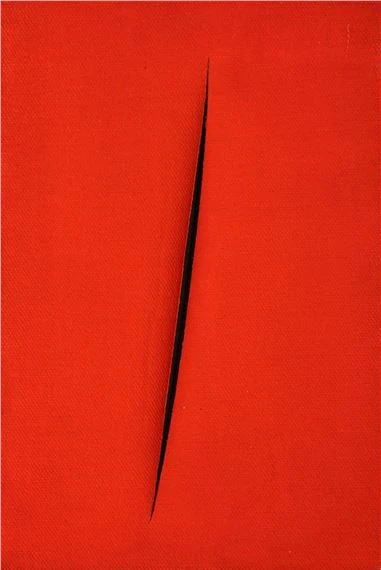
And it always begins with an initial act of differentiation, an initial act of will, a piercing stab into the total sameness of chaos. In cosmogony, this primordial rupture triggers the cascading process of distinction of the fundamental elements of the universe.
Lucio Fontana – Concetto spaziale, Attese, late 1950s.
✵
The ancient Chinese doctrine of the Mandate of Heaven reflects these parallels between cosmological developments and political order. In this cyclical view of history, a ruler loses the Mandate of Heaven -and therefore their divine right to rule- when chaos engulfs China in the form of cosmic disorder, through both natural disaster and acute social strife. The new dynasty that rises during this fall is the one that resets the cycle, by once again building a new order from this chaos. ↩︎
And in the midst of this wide quietness A rosy sanctuary will I dress With the wreath’d trellis of a working brain, With buds, and bells, and stars without a name
John Keats, Ode to Psyche, 1819
We familiarise ourselves and become intimate with a particular branch of knowledge or practice. We pursue it by involving ourselves with it through raw effort, trying to come to new understandings all by ourselves. We get stuck, run into dead ends, watching our hard-built conjectures and conclusions crumble by the occasional spontaneous revelation which arrives to supplant their complexity with simplicity.
It is this familiarity, the joys and pains, the selecting, discarding, meandering that we went through that creates the tree of knowledge and experiences of our own engagement with that particular knowledge or practice (or more simply said, a quest in the sense of a long search).
The tree grows into its own unique shape, rich with decorations, mysterious corners, bends, unexpected superpositions, flowers of whim, hanging vines. It is a tree that began with the seed of an irresistible curiosity, a vital energy pushing us towards a search and an involvement, and from our first forays the roots of our particular approach to it begin to sprout, conditioning the directions our development will take. Then gradually a solid trunk grows as the heart of our search —the recurrent aspects we find the most important, thrilling and worth committing to—, followed by the branches of our own developing ideas and particular details that we follow further. At the same time there appear leaves, flowers, and the fruits of our search (the sweet nectar we offer to others).
And it all continues developing: roots spread further, the trunk grows, its bark’s texture roughens and deepens; new branches sprout from both the trunk and older branches; flowers bloom, decay and bloom again, and so on.
The tree is the path we took towards making a knowledge and/or practice a part of us. It is perhaps slower and more arduous than simpler paths, described within precise recipes, towards a particular goal that we could have taken. Yet, the hardening of foundations that comes from having wrestled with our ignorance and occasional disorientation, the particular detours we unwittingly took that ultimately led to complementary knowledge that gives our approach its own singular brand, and the continuous blossoming of discoveries and creations that takes place as we advance, they are all what makes the path ours.
We got to the “end” (we could call it “mastery”, or “readiness for outwardly contribution in the world) much slower because we found these unique answers by ourselves. No shortcuts exist or are necessary when forging such a path, because the very nature of this path as a “means” to get to an “end”, is that to get to the “end” we need to learn to love the path as if it were a homeland, a sacred tree we embellish and festoon with beautiful garlands, bells, and lights (or as Keats puts it in the poem cited at this text’s beginning: “a rosy sanctuary… the wreathed trellis of a working brain, with buds, and bells, and stars without a name”)
In the end, the tree grew into a unique sight as we internalised an grappled with every detail in our own way, bathing it with our subjective content in a reciprocal symbiotic development (because ultimately we humans are beings of knowledge: we cannot help creating, perceiving and living through knowledge —in a sense, we are knowledge and knowledge is us).
It is beautiful to love the path we take towards a particular search. Certainly, the unique shape of its growth while it becomes a guiding force within us is all a reward in itself. It becomes a part of our identity, and its ripening fruits our gifts to others.
In The Little Prince by Antoine de Saint-Exupéry, this often undervalued type of loving relationship with the world that we humans are capable of is perfectly encapsulated in the image of a rose and the little prince’s love for it, even if an outside observer would say that it is just a rose like any other.
.” . . It’s the time that you spent on your rose that makes your rose so important. . . . You become responsible for what you’ve tamed. You’re responsible for your rose. . . .”
“ Of course, an ordinary passerby would think my rose looked just like you. But my rose, all on her own, is more important than all of you together, since she’s the one I’ve watered. Since she’s the one I put under glass, since she’s the one I sheltered behind the screen. Since she’s the one for whom I killed the caterpillars (except the two or three butterflies). Since she’s the one I listened to when she complained, or when she boasted, or even sometimes when she said nothing at all. Since she’s my rose.”
Nothing in the world as we experience it through our human perspective is static.
The constant motion of things (their interacting, evolving, combining, disaggregating) and their impermanence constitute a universal law as unobjectionable as the passing of time itself – perhaps because impermanence and time are both cause and consequence of each other.
So, given that within our limited minds (in their working memory and their long-term memory) we cannot do more than select and preserve only an infinitesimal part of what we are really experiencing, we need concepts, signs -such as words-, symbols, and imagery that will capture and bundle together aspects of a perceived reality. Through this kind of preservation, we freeze bundles of a partially perceived reality in time, suitable for later reflection, consultation or re-evocation.
What are words, symbols and ideas if not attempts to appropriate some part of reality so that we can later observe it in the out-of-time tranquillity of our imaginations? And perhaps we will follow this with an ideation process: we combine these elements with other elements, along with other impressions we collect in our experience of reality, in order to form new symbolic resources.
However, concepts, language, ideas, symbols… they all require a degree of conventionality so that they can be understood by more than one person. We educate each other so that we can exchange these with the reassurance that the other more or less gets the picture of the captured aspect of reality this concept is meant to contain. Others need to construct a frozen model in their heads similar enough to the one we offer by at least covering its fundamental parts. When we achieve this, we are indeed communicating: making our understanding of this mental object common to both of us.
Every culture and every language (great interconnected webs of frozen bundles of perceived reality and the products of reflection) is also unfolding in a particular moment in time. Even if its available resources for concepts, words, symbols, references, or imagery, are exceptionally large and extensive, the truth is that in every historical moment only a small fraction of this repertoire is deemed acceptable and natural within the conventions of daily life, thus circulating freely in everyday expression, in creation, in how we choose to interpret reality, what to pay attention to, what to retain in our minds for ideation, etc.
What is conventionally facilitated restrains cultural resources, negating the use of the actual entirety of available resources. This results in a great many mental objects (especially words) becoming difficult to use. This can engender distrust and negative dispositions in the guise of accusation of pretentiousness, of eccentricity, of nefarious intentions, of sensibilities that are only adequate for those belonging to an artistic profession, of archaisms, etc.
In essence, the amount of resources that a particular culture offers is vastly superior to what is actually used in almost every context where that culture is involved. The rest lays dormant, frozen in time, a standing reserve awaiting the moment when somehow the arbitrary laws of cultural acceptability makes it common currency instead of rattling incongruity. Fortunately enough, at least they have already been captured in some codified, symbolic form that can be understandable, and therefore potentially communicable, to others familiarised with the same culture.
To confront the chaos of existing in an impermanent and overwhelmingly rich reality, we filter our perception and we capture some of it to hold it together in some permanent form. We are putting a sieve on everything that is happening, selectively freezing certain aspects in time, and some of these resources somehow became the captured elements by default at the expense of all others, preserved in the pages of seldom-read books, works of art, small intellectual circles, niche societies.
Someday their moment might come to become conventional, be it by sheer chance, destiny, or the determination of a determined human will recognising its importance and driving it into the culture.